
Reston Marriage Counseling Alternative
Stop Having the Same
Argument Over and Over
Break the Cycle and Reconnect
A Conflict Resolution Approach to Saving Your Marriage
Most marriage counseling has no finish line. You talk, the hour ends, and the same argument is waiting at home. My approach is built to do the opposite: as a conflict resolution specialist, I work to find what's actually driving the conflict between you and give you a clear path out of it.
That's the key difference — I'm a conflict resolution specialist, not a therapist. Traditional counseling is often non-directive, with the counselor staying neutral. But you aren't neutral about saving your marriage, and neither am I. From the first call, the goal is reconciliation, not open-ended conversation.
That distinction also means no labels. To bill insurance, a therapist must assign a psychiatric diagnosis to at least one spouse — early, and often inaccurately — and it stays on your permanent record. You came for help with your marriage and leave labeled. My work carries no diagnosis and no medical record.
It also means real depth. Each of you completes the Conflict Analysis Tool, an X-ray for your relationship that reveals the patterns and root causes. I've used it with more than 1,000 individuals.
And that's where preparation comes in. Before our second joint session, I spend several hours reviewing everything I've gathered about your relationship and building a clear agenda — so the real work of rebuilding can begin the moment we meet again.
That same investment of time carries into every session that follows. Even once we're underway, I'll typically spend an hour or more preparing between sessions — not the ten or fifteen minutes most counselors manage.
Our time together isn't rushed either. A “therapy hour” runs 45–50 minutes; mine is a full 60. And I'll never open with, “So, what do you want to talk about today?” I arrive with a focused agenda drawn from what you've already told me — then build on it as I learn more from both of you in the room.
The result is focused, faster, and built around your actual relationship.
If your marriage is struggling, the first step is free. Call 703-483-0031. Or, if you prefer, click to learn more about my process

Living in Reston VA
Community Overview
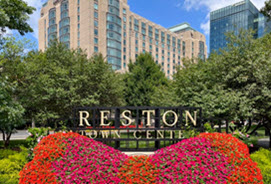
Reston sits in Fairfax County, Virginia, and is home to about 63,500 people. It's a planned community, so you get city conveniences close at hand but a lot more green space than most suburbs. Homeownership is high, the public schools are well regarded, and the town shows up regularly on best-places-to-live lists for the state. It also has a creative streak — more artists, designers, and media people live here than in a typical American town, and that shows up in everything from the public art around Lake Anne to the mix of small businesses in the town center.
Part of what makes Reston feel different is how much of it is given over to the outdoors. The Reston Association maintains over 1,350 acres of open space: 800 acres of woodlands, four lakes, three ponds, four wetlands, 50 meadows, and 20 miles of streams. Wherever you live in Reston, a trail or a lake isn't far. For a lot of households here, a walk around Lake Audubon or an afternoon on one of the pathways is just part of the weekly rhythm — the kind of thing that drew them to the area in the first place.
Community Character
Reston was founded in 1964, one of the first planned communities in the country, and you can still see the plan in how it's laid out. There are walkable town centers and two Silver Line Metro stops, but also quiet wooded neighborhoods and plenty of trails, all about 20 miles from downtown D.C. You get city access and small-town quiet in the same place — a combination that's hard to find this close to Washington.
The people who live here reflect that mix. Reston draws professionals who commute into the District or work in the tech and government-contracting corridors nearby, alongside families who've put down roots for the schools and the open space, and longtime residents who remember when the town was much smaller. It's diverse, well-educated, and busy — and that pace is part of the story. A lot of couples move here expecting a calmer life, then realize careers, kids, and the commute followed them anyway. The demands that pull a marriage in different directions don't disappear just because the setting is pleasant.
Residents writing on Niche.com tend to describe the same thing: the balance between natural beauty and everyday convenience. Trails, lakes, and green space on one side; the shops, restaurants, and services of Reston Town Center on the other. One reviewer called the community “welcoming, diverse, and well-maintained.”
Marriage Counseling in Reston
Reston is a good place to live, work, and raise a family. But a nice town doesn't keep a marriage from running into trouble — and the pressures that wear couples down here are the same ones felt everywhere: long hours, money stress, raising children, and the slow drift that happens when two people stop really talking.
You don't have to stay stuck there. The good news is, I offer couples in Reston an effective alternative to traditional marriage counseling and open-ended talk therapy: we figure out what's actually behind the fighting, then build a plan for changing it. Sessions run over live video, so you handle the work from home and fit it around your job and the kids. I see couples in nearby Herndon and Vienna too. If your marriage feels stuck, get in touch.
Ready to take the first step?
Call 703-483-0031 to speak with me without charge or obligation about your situation. Or, if you prefer, click to learn more about my process
Serving all of Northern Virginia