Chapter 7
Can You Name What You’re Feeling?
Many people find it hard to say what they feel, often because no one ever modeled it for them, or because they were discouraged from trying. In a marriage, that silence can do real damage. The way out, and the way to strengthen your bond, is learning to name out loud what you feel.

Learning About Yourself
Check every statement below that describes you today. There’s no passing or failing score. The point is to acknowledge reality.
True of me
Statements checked: 0
The list above indicates whether or not you struggle with identifying or expressing your emotions. If you do, this chapter contains exercises designed to make you more comfortable processing and naming your emotions.
Who This Chapter Is Talking To
Both of you. And from here on, “you” means whoever is reading at the moment.
That matters, because each of you plays two parts in this chapter, and they are different skills. One part is naming what you feel and saying it out loud. The other part is hearing what your spouse feels without making them regret having said it. Most people are noticeably better at one part than the other, and a marriage only improves when both parts are covered.
Where a section belongs mainly to one part, I’ve marked it at the top. Read all of it anyway. You’ll be on both sides of this before the week is out.
Why Emotional Intelligence Matters in a Marriage
One wife shared this story about her husband, who had little tolerance for her emotional responses and was likely uncomfortable expressing his own.
I was married to a man who wasn’t very emotional, and early in the relationship he would get upset when I cried, so I learned not to. We were married for 13 years.
Two years ago I divorced him, because I met someone who made me feel again. The last two years have been an emotional roller coaster as I’ve let all those feelings finally come back out, with a wonderful man by my side who embraces my “seasons” of emotions, as he calls them.
Being able to relate emotionally to your spouse matters. It is one of the clearest signs of a healthy marriage. The good news is that whatever your background, and whatever your age, it can be learned.
Case in Point
Psychiatrist Dr. Daniel Siegel wrote about a 92-year-old client named Stuart, a retired attorney.2 He and his wife were married, at that point, for 62 years. Because of recent events, Stuart came to see Dr. Siegel at the insistence of his 70-year-old son.
It didn’t take long for Dr. Siegel to notice how little emotion Stuart expressed. In a later session, Stuart’s wife Adriene, age 83, joined him. She described Stuart’s parents as the coldest people she had ever met, and called them “frozen.” The significance is hard to miss. Stuart grew up in a home with very little emotional nurturing or warmth.
Given that upbringing, it’s no wonder Stuart stayed emotionally distant from Adriene for their entire married life. She asked Dr. Siegel to help her husband break out of his shell, even at that late stage.
Dr. Siegel took Stuart through a therapeutic process that turned out to be transformative. Nine months after their first meeting, Adriene called Dr. Siegel and asked whether he’d given her husband a “brain transplant.” By Dr. Siegel’s account, she was astonished at how attuned Stuart had become to what she was feeling, and she said the two of them were happier than they had ever been.
Stuart wrote in his journal that hiding in books was easier, but that books don’t feel as good as love. A year after their last session, Stuart, then almost 94, wrote to Dr. Siegel to say he couldn’t begin to describe how much fun he was having, and that life had new meaning. He was grateful.
Stuart needed professional help to get free of nine decades of emotional confinement. But it happened, at 92. The rest of this chapter is for those of you who want to work on expressing your emotions without professional help.
Identify Your Emotions More Precisely
Your part: naming what you feel
A wine taster doesn’t just taste “good” and “bad.” Wine’s characteristics include tannin, oak, acidity, minerality, and a dozen other things. These differences are what the work depends on. Vocabulary grows wherever the distinctions matter.
The same is true of emotions. It matters that you can name the exact emotion you feel in a given moment. Responding to your spouse with “fine” or “upset” doesn’t fully communicate what you’re actually feeling. The two tools below will help you get more specific.
Tool 1: The Mood Meter
The Mood Meter was developed by Dr. Marc Brackett.1 According to this meter, every emotion can be placed by two measures. How pleasant does it feel, and how much energy is behind it?
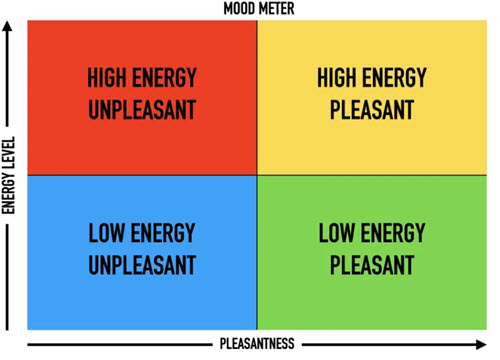
Once you know the quadrant, select the word that fits what you are feeling. These lists aren’t complete, and they aren’t meant to be. If a word that isn’t here describes what you feel more accurately, use that one.
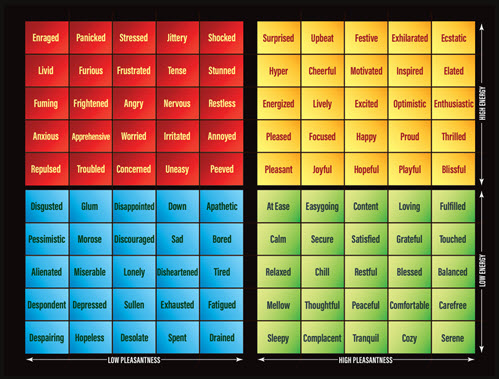
Click here
for a full sized rendering of this chart.
Tool 2: The Wheel of Emotions
Another way to get specific is to start with the broad emotion you know you’re feeling and then narrow it. On the wheel below, published by the Junto Institute, find your general category at the center, then work outward to the word that lands closest.
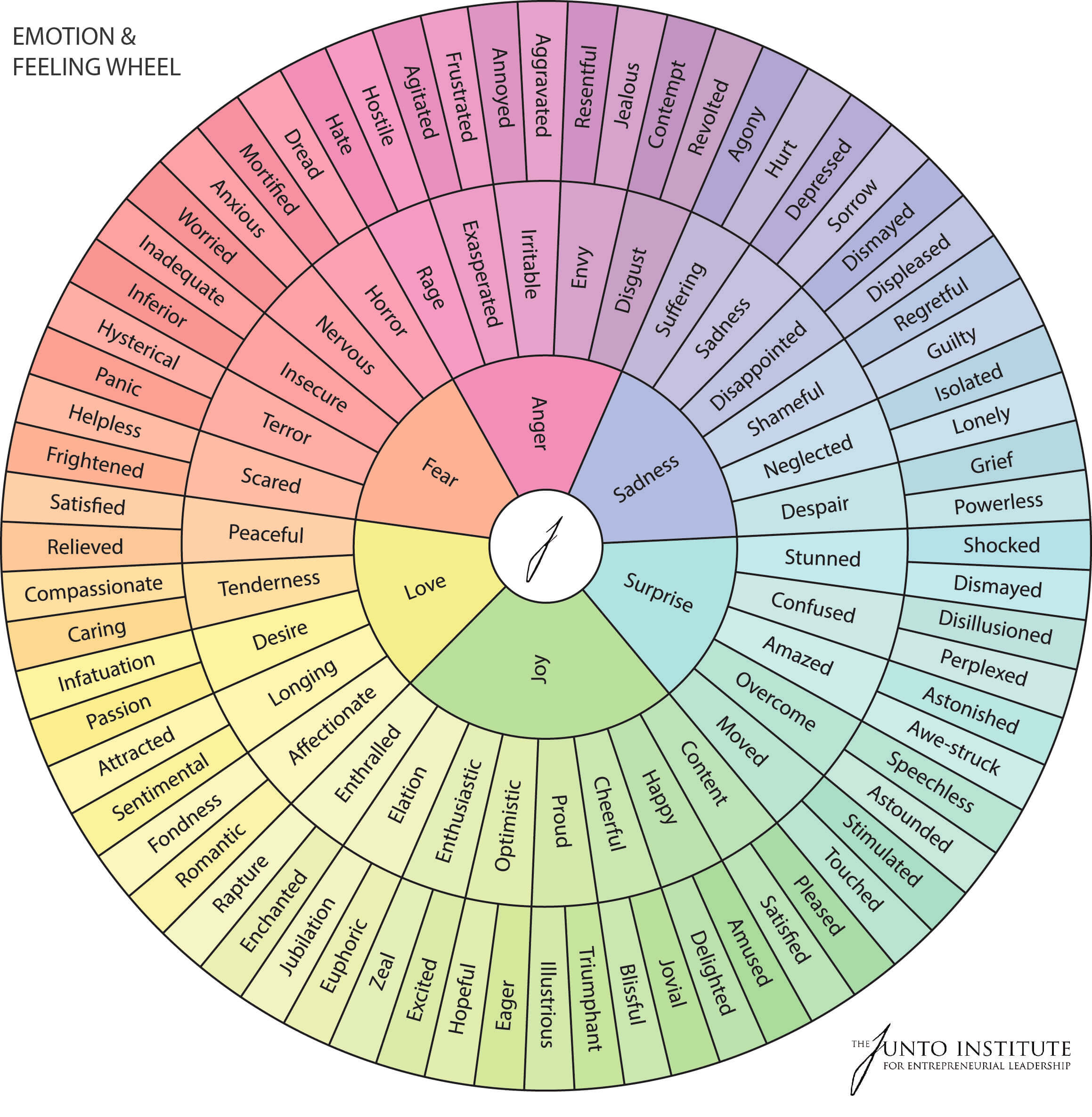
Click here
for a full sized rendering of the wheel.
When the Word You Land On Isn’t the Whole Story
Sometimes the emotion you name is sitting on top of another one. Anger in particular is rarely the first thing you felt. That is the subject of the next chapter. For now, just be aware that the most obvious word isn’t always the truest one.
Is That a Feeling or a Thought?
There is one more precision problem, and it is the most common of all. This one doesn’t come from lacking the right word. It comes from believing you used one when you didn’t.
You say, “I feel like you don’t care about me.” The word “feel” is in there, but without the emotion. That is a thought about your spouse, and it is an accusation. They’ll defend themselves, and the two of you are off and running.
Here is the test. A real feeling is a word that fits directly after “I feel.” If you need to add like, that, as if, or you to finish the sentence, what follows is a thought.
Try it. I feel lonely. The word fits, so it is a feeling. I feel like you don’t care. You needed a connector, so it is a thought.
| What you said | What you meant |
|---|---|
| I feel like you don’t care about me. | I feel lonely. |
| I feel that you’re being unfair. | I feel dismissed. |
| I feel like I’m always the one who gives in. | I feel resentful. |
| I feel you’re not listening to me. | I feel unimportant. |
| I feel like nothing I do is good enough. | I feel discouraged. |
Three things happen when you move to the right column. Your spouse can’t argue with it, because nobody can tell you that you are not lonely. They don’t have to defend themselves, because you haven’t accused them of anything. And they finally learn what is missing. “You don’t care about me” gives your spouse nothing to do with the information. “I’m lonely” tells them exactly what you need.
Both columns may be true. Only one of them uncovers the emotion.
Those are the three skills of naming (using the Mood Meter): (1) the right quadrant, (2) the right word, and (3) a feeling rather than a thought. What follows is what they sound like when a couple actually uses them.
One more thing, and it points ahead. This chapter asks whether you named a thought or a feeling. The next chapter asks a harder question about that same thought, which is whether it is even true.
What A Brief Emotional Conversation Sounds Like
Here is a short exchange with everything above in it. The answer starts with a quadrant and lands on a precise word. The follow-up question gets at the thought underneath. Read it twice, once in each part, because you will be playing both.
Asking: How are you feeling?
Answering: Low energy, unpleasant. Discouraged, I think.
Asking: What’s going on?
Answering: The meeting today. I put six weeks into that proposal and nobody said a word about it.
Asking: That sounds lousy. Thank you for telling me.
Notice what the asking spouse didn’t do. No reassurance that the meeting probably went fine. No advice about how to handle the boss. No suggestion that discouraged is the wrong thing to feel. One question and a thank you, and the door stays open for tomorrow.
That one was easy, because the trouble came from outside the marriage. Here is the harder case, where the trouble is the person in the room.
Asking: You’ve been quiet all evening. How are you feeling?
Answering: Low energy, unpleasant. Hurt, I think.
Asking: What’s going on?
Answering: You made plans for Saturday without checking with me.
Asking: I didn’t realize. Thank you for telling me.
Notice what the asking spouse did. They took in a feeling that was about them without defending themselves. No explanation of why the plans were made that way. No reminder of the last time the shoe was on the other foot. That is the hardest version of listening, and it is the one that decides whether your spouse hands you the truth next time.
Before You Start the Exercises
Discuss
Review your answers to the checklist above. Share, as best you can, why you think you struggle with your emotions, assuming you do. The goal of this conversation is to help your spouse understand you. It isn’t to make any changes yet.
WARNING! When Your Spouse Names a Feeling
Your part: hearing what your spouse feels
Everything above trains you to say what you feel. This part trains you to hear it. It is the half that gets skipped, and skipping it is the usual reason these exercises fail. When your spouse names an emotion, four things will tempt you. Resist all four.
- Don’t correct it. “You’re not really angry, you’re just tired” tells your spouse you know their insides better than they do.
- Don’t argue it away. A feeling isn’t a claim to be refuted. It’s a report.
- Don’t rush to fix it. Solving the problem is often a way of ending the conversation.
- Don’t make it about you. “So you’re saying I’m a terrible husband” moves the spotlight, and the disclosure stops.
What’s left is small, and it’s enough. Ask one question. Say thank you. Do that ten times and your spouse will keep telling you.
Pace Yourself
Work on one exercise at a time. Feel free to give yourself a week before you move to the next one. These are skills, and skills don’t respond to cramming.
Additional cautions. Some of the honest answers will be hard to hear. Your spouse may tell you they feel trapped, or numb, or contemptuous. Take it in, thank them, and take up the substance another day. Argue with the answer and you’ve taught your spouse that honesty costs too much.
And if telling your spouse how you feel has been used against you in the past, don’t start here. Start with a professional. The same goes if these exercises are making things worse between you rather than better. That’s information, not failure.
Six Exercises to Increase Emotional Connection
Exercise 1
How Are You Feeling? (Quadrants)
Your part: naming what you feel
When your spouse asks how you’re feeling, instead of saying “fine,” try a different approach. Using the four quadrants above, answer in one of these four ways.
- My energy level is up, and I’m in a pleasant mood.
- My energy level is down, and I’m in a pleasant mood.
- My energy level is down, and I’m in an unpleasant mood.
- My energy level is up, and I’m in an unpleasant mood.
Use this with each other several times a day. It’s a plain starting point, and that’s the idea. You’re building the habit before you build the vocabulary.
Exercise 2
Guess the Feeling (Quadrants)
Your part: reading your spouse
a. Watch a television program or a movie together at home. When you see an emotion on screen, pause and name the quadrant it belongs to. Does your spouse agree? If not, talk about what each of you saw. Keep doing this until you agree most of the time, then move on to part b.
b. Now do it with each other. Try to read what your spouse is feeling without being told. The goal is to get it right more often than not. Once you can, move on to Exercise 3.
Exercise 3
How Are You Feeling? (Precise Words)
Your part: naming what you feel
When your spouse asks how you’re feeling, answer with a word from the detailed Mood Meter or the Wheel of Emotions. Be as specific as you can about the exact emotion. Use this with each other several times a day.
Exercise 4
Guess the Feeling (Precise Words)
Your part: reading your spouse
a. Watch a program or movie together. When you see an emotion displayed, pause and name it using a specific word rather than a quadrant. Does your spouse agree? If not, discuss what each of you saw. Keep at it until you agree most of the time.
b. Then see if you can do it with each other. Try to name your spouse’s precise mood on a daily basis.
Exercise 5
Ask Your Spouse Why They Feel That Way
Your part: hearing what your spouse feels
a. After your spouse tells you how they’re feeling, ask why. Don’t argue. Your goal is to learn the thoughts behind the emotion, not to debate them.
b. Don’t argue about whether the thought is accurate, at least not yet. The next chapter gives the two of you a way to test it together.
Exercise 6
What Does Your Body Do When You Argue?
Your part: naming what you feel
Check everything that happens to you during an argument with your spouse.
Sensations checked: 0
Our emotions live in our bodies as much as in our brains. Psychologist William James put it well more than a century ago when he wrote that emotion cut off from all bodily feeling is inconceivable.3
Researchers in Finland gave more than seven hundred people a blank outline of a body and asked them to color in where each emotion made them feel more activity, and where less. The maps came back strikingly similar from one person to the next, and across three different cultures.4 Anger lit up the chest, the head, and the hands. Sadness drained the arms and legs. Love filled almost the entire body. Depression showed very little anywhere.
So if you’re unsure what you’re feeling, ask yourself what’s going on inside your body. Use the list above to locate the sensation. Then ask what the sensation is telling you. If the pit in your stomach could speak, what would it say? What emotion is it connected to?
Review and Reflect
Key Takeaways
- Struggling with emotions isn’t a character flaw. For most people it’s a skill nobody taught them or modeled for them.
- “Fine” and “upset” are too broad to be useful. Place the feeling by energy and pleasantness, then find the precise word.
- A real feeling is a word that fits right after “I feel.” If you need like, that, as if, or you, you said a thought.
- Hearing a feeling is its own skill. Don’t correct it, argue it away, fix it, or make it about you. Ask one question, then say thank you.
- Stuart changed at 92. Age and a lifetime of habit are not the obstacles people assume they are.
First, On Your Own
- Review the statements you checked at the top of the page. What do they have in common?
- When did you learn that showing emotion was risky? How did you come to believe it?
- What do you expect would happen if you told your spouse exactly what you feel? Where did that expectation come from?
- Which part comes harder for you, naming what you feel or hearing what your spouse feels?
Then, Together
- Share the statements you checked. The listener’s only job is to take it in.
- Tell your spouse one thing they could do that would make it easier for you to open up.
- Agree on which exercise you’ll start and what time of day you’ll do it.
1. The Mood Meter was developed by Marc Brackett, Ph.D., and the Yale Center for Emotional Intelligence, and appears in his book Permission to Feel. ↩
2. Daniel J. Siegel, M.D., Mindsight: The New Science of Personal Transformation, chapter 6. ↩
3. William James, The Principles of Psychology (1890), chapter 25. ↩
4. Lauri Nummenmaa and colleagues, “Bodily maps of emotions,” Proceedings of the National Academy of Sciences, 2014. ↩
Struggling in your marriage? There is hope.
Call Dr. Ken Newberger at 703-483-0031 to talk about your situation free of charge. Or, if you prefer, learn about his unique process.