Chapter 14
To Forgive or Not to Forgive? That Is the Question
Forgiveness in marriage is an exchange between two people. The spouse who did wrong admits it and apologizes. The hurt spouse stays willing to forgive and grants it when the apology comes. Forgiving privately, with no apology, leaves the relationship unrepaired.

I came across this question regarding forgiveness on the internet.
Recently one of my family members hurt me badly. They believe I am an easy target since I don’t want to retaliate or cause conflicts. My question is should I take the risk of getting revenge, knowing that it is never ending (not the best solution) or should I forgive this person?
In this chapter we consider the subject of forgiveness in the following three ways:
- Forgiveness advice commonly found in the U.S. today.
- Forgiveness from a Judeo-Christian perspective, one that spans thousands of years.
- Forgiveness as it applies to marriage today.
This is the only chapter in the book that presents a Judeo-Christian perspective. I include it because what the Bible teaches about forgiveness speaks directly to what happens in a marriage when one spouse hurts the other. You don’t have to share that faith to benefit from it.
Forgiveness Advice Commonly Practiced in the U.S. Today
There are two concepts that are widely found in the U.S. today.
The first is, when we forgive others, we do it for our sakes, not theirs. The second concept is, forgiveness is not necessarily a social event but something that can be practiced in solitude. In other words, the offender may not even be aware of it. Consider the following examples:
Forgiveness is for You, Not Anyone Else, reads the title of an article written by a psychologist.
A marriage and family therapist similarly wrote, Forgiving someone is for your benefit, not theirs.
One health reporter wrote, forgiveness doesn’t mean letting someone off the hook… In fact, you may never say the words “I forgive you” out loud. Instead, forgiveness is an internal process, something you do to help come to terms with a past experience and end your suffering, pain, anger, and resentment around the event.
An article on the Johns Hopkins Medicine website says that once you have forgiven, seal it with an action. And what is that action? If you don’t feel you can talk to the person who wronged you, write about your forgiveness in a journal or even talk about it to someone else in your life whom you trust.1
Last, hear the words of one jilted lover. “I forgive you for depriving me and for stealing my happiness. I forgive you for accusing and rejecting me when I needed you most. I forgive you for breaking my heart when all I did was to give you love. I forgive you, not for you but for me to let go of this anger and find inner peace.”
The recurring theme of these and similar statements is that forgiveness is for the forgiver, for their mental health and well-being. Involvement of the offender is unnecessary. Unless the offender has died, or you choose to overlook the offense, this approach, I believe, is flawed.
How Would Such an Approach Work in Marriage?

Consider this scenario: You discover that your spouse has been having an affair. What should you do? If forgiveness is for you, how would this scenario play out?
When, for example, do you forgive your mate for your sake? Right away? After more details spill out? If forgiveness is for your benefit, it would seem the sooner you do it the better.
What if your spouse doesn’t want to end the affair? You are emotionally devastated. Do you forgive your partner for your sake, then?
And if you truly forgive your mate to find inner peace, how can you ever go back and rehash what you have already forgiven? When a court of law acquits someone, there is no possibility of going back to litigate the case again. The case is closed. Would forgiveness not be the same thing? The case was closed for your mental health. What would be the purpose of further conversation?
Moreover, if forgiveness is for you and not your spouse, how can you ever hold your spouse accountable? If you forgive for your sake, how can you find out such upsetting details such as when the affair began, why it occurred, with whom, for how long, etc., etc. Where is the accountability? There is none.
And if your spouse is not required to be accountable because you have already forgiven him/her, what motive would your partner have to change behavior? Your partner’s participation is irrelevant to this entire process.
The confusion and frustration that results from putting the cart in front of the horse and expecting to get anywhere should be obvious.
To recap, when forgiveness is for you and not your mate:
- No apology is required.
- No discussion is required.
- No accountability is required.
- No change in behavior is required.
- The relationship remains unrepaired.
Forgiveness from a Judeo-Christian Perspective
In this section, I want to discuss forgiveness from the Judeo-Christian perspective, one that spans thousands of years. This model is based on the Biblical premise that we forgive others the way God forgives us.2
Note: I realize not everyone accepts the Biblical description of God and how He forgives us. Yet, you can benefit from what the Bible says about forgiveness without accepting the premise that it is divinely inspired.
I outline the model below. At the end of this chapter, I apply it to couples.
The Four Main Points of the Judeo-Christian Model
- Forgiveness is for the offender, not for the offended.
- Forgiveness is based on the offender’s confession of wrongdoing and an apology to the person who suffered loss.
- If the offender does not or refuses to apologize, the injured party maintains an attitude of being “willing to forgive.”
- When someone offers a genuine apology and the offended person grants forgiveness, if both parties are willing, they can bring the relationship back to life.
1. Forgiveness Is for the Offender, Not for the Offended

The meaning of the primary Greek word for forgiveness in the New Testament is “to release,” as in a lender’s forgiving a borrower’s debt. Even at this basic level, we can see that the one who benefits is the borrower who is “released” from his or her obligation. The psychological mind-set of the one forgiving the debt is not in view.
In the same way, when God forgives us it is for our sake, not for His. We become free from the punishment for our sins.
Here are some passages in the Old Testament that poetically describe God’s forgiveness this way:
As far as the east is from the west, so far does He remove our transgressions from us.3
You have cast all my sins behind Your back.4
You will cast all our sins into the depths of the sea.5
In the New Testament, when Jesus told an immoral woman,
Your sins are forgiven… Go in peace6
the impact of this interaction was to release the woman, not Jesus, from the burden of sin.
When Peter preached the gospel after Jesus' resurrection, he declared,
To him all the prophets bear witness that everyone who believes in Him receives forgiveness of sins through his name.7
It is the sinner, the object of God’s forgiveness, who is set free.
Charles Wesley, one leader of the Methodist movement in the 1700s, wrote thousands of hymns, including one entitled “And Can It Be.”8 He wrote it not long after he found peace with God, and it describes what it felt like to be forgiven. Notice who is set free.
My chains fell off, my heart was free
I rose, went forth, and followed Thee…
No condemnation now I dread

The 19th-century French poet Eugénie de Guérin similarly wrote,
When the soul has laid down its faults at the feet of God, it feels as though it had wings.9
To sum up, a Judeo-Christian perspective plainly teaches that forgiveness benefits the offender who was forgiven.
2. Forgiveness Is Based on Confession of Wrongdoing by the Offender
The Bible teaches that God’s forgiveness is conditional upon a sinner’s repentance. One Biblical encyclopedia succinctly put it this way, “God does not forgive without repentance.”10 Likewise, our forgiveness of another is based on the offender’s repentance. Jesus taught,
If your brother sins, rebuke him; and if he repents, forgive him. And if he sins against you seven times a day, and returns to you seven times, saying, ‘I repent,’ you shall forgive him.11
Jewish teaching puts the same responsibility on the one who did the wrong. Maimonides is one of the most celebrated rabbis in history. In his Laws of Repentance, he wrote,
Repentance and the Day of Atonement atone only for sins between a person and God…. But sins between a person and his fellow, such as injuring him, cursing him, or robbing him, are never forgiven until he gives his fellow what he owes him and appeases [makes peace with] him. Even if he has returned the money he owes, he must appease [make peace with] him and ask his forgiveness.12
When the Stakes Were a Matter of Life & Death
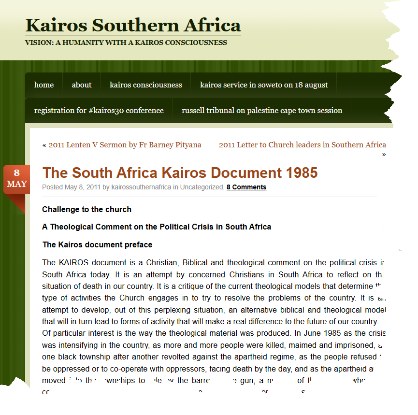
In 1985, when apartheid [a system of racial discrimination and gross human rights violations by white South Africans against black South Africans] was in full force, 156 theologians from over 20 South African denominations produced the Kairos Document. The very first sentence reads, “The KAIROS document is a Christian, Biblical and theological comment on the political crisis in South Africa today.”
These Christian leaders were emphatic on the point that there is no forgiveness without repentance. They wrote,
In our situation in South Africa today it would be totally unChristian to plead for reconciliation and peace before the present injustices have been removed…. What this means in practice is that no reconciliation, no forgiveness and no negotiations are possible without repentance. The biblical teaching on reconciliation and forgiveness makes it quite clear that nobody can be forgiven and reconciled with God unless he or she repents of their sins. Nor are we expected to forgive the unrepentant sinner. When he or she repents we must be willing to forgive seventy times seven times but before that, we are expected to preach repentance to those who sin against us or against anyone.13
For peace to be achieved between estranged parties, the wrongdoer must acknowledge their wrongdoing and admit that they have done wrong. In the same way, an apology is not effective by merely talking to oneself (previous chapter), neither is forgiveness.
Before the one who suffered loss “forgives and forgets,” the one who caused it must “remember and repent.”
Illustration
A man told about an event that occurred when he was a teenager. When no one was there, thieves broke into his family’s home and went on a stealing spree. Only as the days wore on did the family begin to realize not just how many things were stolen but how many things that had sentimental value were gone. One such item was a special ring that belonged to the father. The ring had been given to him by his father the very day his father passed away. The man recalled, “I had never seen my dad cry, but he cried that day, and his tears were replaced by a deep anger. He vowed to kill the burglars, if he ever found them. Hearing my father, a peaceful man, speak those words scared my family.”

About a week later, during suppertime, the doorbell rang. At the door was a woman with a shopping bag and her teenage son. After being invited inside, the mother explained why they were there. Days earlier, she noticed her son wearing a new ring. She asked him where he got it. Finally, after some prodding, the teen said that he and some buddies had broken into a house and stole it, along with other items. The mother was aghast by what her son had done. The boy himself was having second thoughts and feeling remorseful. She told him to gather all the things he had stolen in a bag and return them to the owner. She would go with him.
As the details began to pour out, the narrator recalled, “With fear and uncertainty we watched my dad. We could see the angry glare in his eyes.” After the story of what had happened was fully told, the teen said directly to the father, “Sir, I am sorry.” The boy then started to cry. He admitted what he did was wrong and was willing to give the names and addresses of his accomplices to the police department.
At that very moment when he had confessed all, the young thief surrendered his immediate fate into the hands of the very one he robbed. And it was at that moment that the father’s demeanor dramatically changed. The accusatory glare in his eyes disappeared. The hard attitude he had been expressing because of the pain of his loss was replaced by a spirit of gentleness. Even though the sense of violation to the sanctity of the home was not restored, and even though there were many more items likely lost forever, given the apology and supporting evidence to show its sincerity, the father declared, “I forgive you.” After the father gave him a fatherlike talk, he asked the teen and his mother to stay for dinner, which they did.
[Postscript: The teenager courageously kept his word and told the police about the incident and those involved. The danger then became so intense that it compelled him and his family to move away, which, in hindsight, may have been the best outcome for the teen.]
3. The Offended Party Maintains an Attitude of Being “Willing to Forgive”
In the Old Testament we read,
But you are a God ready to forgive, gracious and merciful, slow to anger and abounding in steadfast love.14
God stands ready to forgive those who seek it.
In the New Testament, we read the Lord is
not willing for any to perish, but for all to come to repentance.15
That is, those that have not acknowledged their sins, God is willing to forgive but does not do so until they repent.
Rabbi Maimonides asks the same readiness of the one who was hurt:
It is forbidden for a person to be cruel and refuse to be appeased [to make peace]…. When the one who sinned against him asks his forgiveness, he should forgive him with a whole heart and a willing spirit.16
We find this same sentiment reflected in the Kairos Document signed by 156 Christian theologians (quoted above). Despite all the injustices that were committed against South Africa’s black citizens, these Christian leaders stated, we must be willing to forgive.
Being willing to forgive people who have hurt us means that our attitude is one of love. As with God, so with us. Whereas God’s love is unconditional, His forgiveness is conditional. Adopting such a mindset frees victims from psychological turmoil because of what someone else did to them.
Moreover, the unapologetic offender is still being held accountable for his or her actions. This is significant. How so? To turn a blind eye when a person hurts us or others, to remain silent when someone does something wrong, to fail to call upon such a person to change his or her ways is not showing love. It is evidence of cold indifference and a lack of love.
Removing accountability eliminates the motivation for offenders to change. In fact, silence represents tacit approval of continued injustice. The wrong becomes tolerated and justice is perverted. As one blogger wrote, “We are doing offenders a disservice if they are not held responsible for their actions. It is only through being held responsible that they are able to see the errors of their ways, change, and grow.”
Maintaining an attitude of “being willing to forgive,” it turns out, is good for everyone.
4. When the Apology-Forgiveness Interaction Occurs, Relationships Can Be Restored
In the apology-forgiveness event, a unique exchange takes place. On the one side of the equation, the offender, without defense, offers a sincere apology, and if restitution is possible, provides it (e.g. the return of a stolen checkbook). On the other side of the equation, the damaged party in essence says, “I will bear the suffering you caused me and release you from any other obligation.”
Human forgiveness mirrors divine forgiveness in that those who forgive rise above the impact of the wrong committed against them. Without this, the world would be an intolerable place to live. As the Jewish author Hannah Arendt wrote in her book The Human Condition, without being forgiven, released from the consequences of what we have done, our capacity to act would, as it were, be confined to one single deed from which we could never recover.17
As It Relates to Marriage
Earlier, we considered this scenario: You discover your spouse has been having an affair. What should you do? This was followed by a discussion of the practical problems of forgiving one’s spouse without an apology for your own sake, not theirs. Let’s now look at a similar scenario from a Judeo-Christian perspective.
A True Account. Consider Tom, a married man, whose job frequently required out-of-town travel.18 On one occasion, he was sitting alone in his motel room. Flipping through the city’s entertainment guide, he repeatedly turned back to the advertisement of an exotic dancer, a past Miss Peach Bowl winner.
At first, he dismissed her show as out of bounds. But the longer he sat around watching TV, the more the image of this strip-tease dancer played upon his mind. “Why not?” he asked himself. A variety of rationalizations bolstered his resolve to go. Before long, Tom found himself in the back seat of a cab headed for the seamy side of town.

The taxi driver dropped him off several blocks from the bar. Given his reputation back home as a community leader and happily married family man, Tom wanted to play it safe. Even though he was a stranger in town, he glanced nervously over his shoulder as he walked closer to his destination, and then entered quickly.
Miss Peach Bowl was everything the ad claimed she would be. Tom felt captivated as she went through her routine. When he exited the establishment a couple of hours later, everything was the same and yet everything had changed. He had crossed a line previously out of bounds. He was still the same person, but his perception was now somehow different.
It wasn’t long after that Tom wanted more. He started to frequent strip joints regularly, purchase Playboy and other sexually oriented magazines, patronize adult movie theaters, and view live peep shows. (This occurred at a time shortly before the internet.)
Down the Winding Road. As the seasons came and went, Tom sadly learned that lust does not fulfill, it “stirs up.” It points in one direction only, downward. There is no returning to a previous level and remaining content. One always wants more. “I no longer wonder how deviants can get into child molesting, masochism, and other abnormalities,” he reflected. “Although such acts are incomprehensible to me, I remember well that where I ended up was also incomprehensible to me when I started.”
Though he had repeatedly attempted to break his habit, he found he could not go a month or two before he yielded once more. Self-hatred, despair, and guilt grew. Over time, an invisible barrier developed between him and his wife, Susan, including the privacy of their bedroom. Tom’s sexual relations with his wife could not compare to the technicolor fantasies into which he had so thoroughly immersed himself.
After years had passed, two unanticipated events occurred which had a dramatic impact. On previous occasions, when trips brought him to New England, Tom would become invigorated by walking along the coast. He loved the smell of the ocean wind and the sound of the waves breaking upon the rocks. But on this occasion, the experience produced no feelings at all. Tom felt dead inside. The seedy images of pornography had become more real to him than reality. He had reason to look at his life in a way he never did before.
Also, just three days later, Tom got to spend time with his friend who he admired. Tom felt he had to reveal his burden to someone. Steve was a man he trusted. After a hesitating start, Tom shared the secret side of his life.
Steve’s response was unanticipated. After Tom finished his story, Steve broke out in an uncontrollable sob. When he finally recovered, Tom learned his friend was not crying for him, but for himself. Steve was where Tom had been five years earlier.
Tom reveals, “I will not dwell on sordid details, but my friend had tried it all… He reached inside his vest pocket and pulled out a pad of paper showing the prescriptions he took to fight the venereal disease and… infections he had picked up along the way… I worried about cognitive dissonance; he brooded on suicide. I read about deviance; he performed it. I winced at subtle fissures in my marriage; he was in divorce litigation.”
Tom was shocked, yet he recognized that his friend had ended up in a place where his own obsession would likely lead him. Fear gripped him. He desperately wanted out of the downward spiral.
The Turning Point. Shortly thereafter, Tom did two things. First, he read a book by François Mauriac. Mauriac, a Nobel Prize winner from France, wrote about the depths of human depravity and personal purity. As a consequence, Tom was motivated anew to humbly approach God in prayer acknowledging his weakness and the need for His strength to break the vicious cycle that held him. Mauriac reminded his readers of the words of Jesus, “Blessed are those who hunger and thirst for righteousness, for they shall be satisfied.”19 Tom asked himself, “Could God substitute another thirst and another hunger for the one I had never filled?” He was willing to find out.
Tom did something else. One night at home, he confessed to his wife the hidden and embarrassing detours of his life. Recalling that long conversation, Tom related, “somehow, she incarnated the grace of God for me.” Susan forgave him for the years of her own silent suffering, for the relationship that never fully developed, and for the rejection she felt at his need to go elsewhere.
To reflect the sincerity of his remorse, Tom would openly share with Susan every temptation he encountered from that point forward. His sex life, which for so long was experienced in isolation, would no longer remain a private matter.
During the next year, Tom relapsed once, and that was the last time. Eventually he wrote his story for publication. Five years later, Tom re-read his original article to prepare for a follow-up story. The extent of Tom’s rehabilitation is captured in his extraordinary words, “I had forgotten how completely sex had dominated my life.” He also wrote that he found “sexual fulfillment at home with my wife.”
Tom’s recollection of events is autobiographical and therefore does not go into detail regarding how his wife processed his heartfelt confession apart from the fact that she forgave him. What we see, however, is the impact of her forgiveness on Tom. It was transformational.
Observations
The repair to Tom’s marriage would not have taken place or have been so complete if not for his confession and Susan’s forgiveness. Returning to the 4 aspects of forgiveness from a Judeo-Christian perspective (see above):
- When Tom’s wife forgave him, it was for his sake, not hers.
- Tom’s full confession and sorrow was essential to the healing of the relationship.
- Susan was willing to forgive Tom, which she did after his confession.
- Over time, the relationship was restored.
Putting This to Work in Your Marriage
The model is simple to describe and hard to live out. Here’s what it looks like between a husband and wife.
If You’re the One Who Did Wrong
Name what you did. Say it in plain words. “I lied to you about the money” tells your spouse you understand exactly what you did.
Leave out the excuses. An explanation added to an apology usually sounds like a defense. The previous chapter covers what a sincere apology includes.
Make it right where you can. Return what you took or repair what you can, as the young thief did when he brought back the ring.
Ask for forgiveness, and then wait. Your spouse may need time. Pressing for a quick answer turns your apology into a demand.
Show it over time. Tom told Susan about every temptation from then on. Changed behavior is what makes an apology believable.
If You’re the One Who Was Hurt
Tell your spouse what hurt you. Be specific. Your spouse can’t confess a wrong they don’t know caused you pain, and saying nothing lets it go unaddressed.
Stay willing to forgive. Until your spouse owns the wrong, keep the door open. That willingness keeps bitterness from taking root while you wait.
When the apology comes, say “I forgive you” out loud. Hearing those words is what releases your spouse, just as the father’s words released the young thief.
Don’t bring it back up as a weapon. Once you’ve forgiven, the wrong is settled. You may still need to talk about rebuilding trust. Raising the old wrong to win a later argument undoes the forgiveness you gave.
Summary
Forgiveness allows us to become free from the past and create a better, more peaceful future. It transforms our world “in a way that can only be described as miraculous.” Why? Because the apology by the guilty party admits the wrong that was committed, while the expression of love and forgiveness by the one who was hurt supersedes it!20
So what about the person at the start of this chapter, who asked whether to take revenge or forgive? Revenge won’t repair that relationship, and neither will forgiving in private. Stay willing to forgive, and tell the family member plainly what was done. When that person owns the wrong and apologizes, forgive.

Discuss
Your Own Experience with Forgiveness
- 1.Do you have difficulty being forgiven by your spouse when you do wrong? If so, why?
- 2.I have experienced being forgiven by (check all that apply):
- ___my parents/caregivers
- ___my spouse
- ___friend(s)
- ___God
- ___no one
- 3.What happened to the relationship after you were forgiven?
- 4.In the past, I have chosen to forgive ____ (identify the person and relationship you had with that person):
- 5.What happened to the relationship after that?
- 6.Do you have any reasons you won’t forgive your spouse if s/he does truly apologize? Use the checklist below.
I do Not forgive my spouse because (check All that are true):
- a. ___I am too angry to forgive.
- b. ___I am too hurt to forgive.
- c. ___I am not ready to forgive.
- d. ___It normally takes me a long time to forgive.
- e. ___my spouse has not taken full responsibility for his/her actions.
- f. ___my spouse doesn’t fully appreciate the pain s/he caused me.
- g. ___the growing list of my spouse’s offenses against me is too long.
- h. ___I have yet to receive a sincere apology.
- i. ___the apology usually comes with an excuse, justification, or defense of his/her actions.
- j. ___his/her past apologies were not sincere - the offending behavior didn’t stop.
- k. ___his/her past apologies were not sincere - wrongs were not made right.
- l. ___my spouse should first suffer for what s/he did.
- m. ___the damage done is too great.
- n. ___what my spouse did is unforgivable.
- o. ___I do not want to reconcile.
- p. ___I want to keep my distance from him/her.
- q. ___I don’t know how to forgive.
- Other:____________________
- 7.What has to happen for you to come to the point where you can forgive your mate?
- 8.If you cannot forgive your spouse right now, would a change in his/her behavior make a difference? If so, such as what?
- 9.Lastly, do you need to apologize and ask your spouse’s forgiveness for something you have done? If yes, why not do it now?
When hurts go unconfessed and unforgiven, conflict between a husband and wife tends to grow. How it grows, and what you can do about it, is the subject of the next chapter, “The Escalating Stages of Marital Conflict.”
1. Johns Hopkins Medicine, “Forgiveness: Your Health Depends on It,” featuring Karen Swartz, M.D., director of the Mood Disorders Adult Consultation Clinic at The Johns Hopkins Hospital. ↩
2. In addition to my Ph.D. in Conflict Analysis & Resolution, I also hold a Master of Theology degree. For those interested, I made this presentation more fully in my first book, Hope in the Face of Conflict: Making Peace with Others the Way God Makes Peace with Us. ↩
3. Psalm 103:12 ↩
4. Isaiah 38:17 ↩
5. Micah 7:19 ↩
6. Luke 7:48, 50 ↩
7. Acts 10:43 ↩
8. Wesley, Charles, “And Can It Be That I Should Gain” (1738), written not long after his conversion on May 21, 1738. Charles, the younger brother of Methodist founder John Wesley, wrote more than 6,000 hymns. ↩
9. Guérin, Eugénie de (1805-1848), French poet and diarist, and sister of the poet Maurice de Guérin. ↩
10. The International Standard Bible Encyclopedia, “Forgiveness.” ↩
11. Luke 17:3-4 ↩
12. Maimonides, Mishneh Torah, Laws of Repentance (Hilchot Teshuvah) 2:9, translated from the Hebrew. A published English translation by Eliyahu Touger is online at Chabad.org. ↩
13. Challenge to the Church: A Theological Comment on the Political Crisis in South Africa, known as the Kairos Document, September 1985, from its discussion of reconciliation. A revised second edition appeared in 1986. ↩
14. Nehemiah 9:17 ↩
15. 2 Peter 3:9. See also 1 Tim. 2:4. ↩
16. Maimonides, Mishneh Torah, Laws of Repentance (Hilchot Teshuvah) 2:10. Translation adapted from Eliyahu Touger (Moznaim Publications), online at Chabad.org. ↩
17. Arendt, Hannah, The Human Condition (Chicago: University of Chicago Press, 1958), 237, in the section “Irreversibility and the Power to Forgive.” ↩
18. Tom’s story is drawn from “The War Within: An Anatomy of Lust,” Leadership (Fall 1982): 97-112, published with the author’s name withheld. His follow-up, “The War Within Continues,” appeared in Leadership in Winter 1988. ↩
19. Matthew 5:6 ↩
20. After a genuine apology is offered and forgiveness is granted, the parties agree concerning the past, not necessarily the future. In cases where there was not a relationship with the offender prior to the offense (e.g. stealing your car), there will likely be no relationship with that person after the apology-forgiveness event. In the case of rape, even if there is a genuine apology and forgiveness regarding the past, it is unlikely that the victim will want to chart a course for the future that includes the one who raped her. The point being made here is forgiveness of the past and reconciliation in the future may overlap, but not necessarily. It will be up to each person. ↩
Struggling in your marriage? There is hope.
Call Dr. Ken Newberger at 561-490-4991 to talk about your situation free of charge. Or, if you prefer, learn about his unique process.