Chapter 12
Conflict with Your Spouse: Is It Possible You Are Wrong?
You can be completely sincere and still be wrong. That’s why admitting fault in marriage starts with one hard question: What evidence doesn’t support my view? Ask it honestly, and many fights end before they begin.

It has been said that the greatest fault of all is to be conscious of none.1 Why? Because if you are not conscious of your own faults, you cannot correct them.
Consider this fascinating and true story about how the human mind can become convinced that what it believes is true when, in reality, it is false. At the end of the chapter, I will discuss its relevance to marriage.
Facilitated Communication
A Father Accused
The authorities issued a warrant for his arrest. They alleged he had sexually abused his son, now 17. The father protested his innocence. Even so, Robert (not his real name) was forced out of his home for the next six months and prohibited from having any contact with his son.
What makes this case so extraordinary is that the graphic accusations originated with a boy who was autistic from birth, that is, one with whom meaningful communication was minimal to non-existent. How could this be?
The Belief
Let’s go back to January 1992 and the television program PrimeTime Live with Diane Sawyer. She began, “And now a story about hope. For decades, autism has been a dark mystery, a disorder that seems to turn children in on themselves.… Tonight, however, you are going to see something that has changed that. Call it a miracle. Call it an awakening.” Call it “facilitated communication.”2
For the first time, autistic children diagnosed with a brain development disorder were showing the world that it was wrong. Many such children were now doing algebra, diagraming sentences, writing poetry, and expressing feelings. They did this without speaking, through the help of “facilitators” who held up and supported their arms. The autistic children would then touch letters or numbers on a keyboard to spell out their thoughts.

Interest in this new discovery spread like wildfire. By 1994, thousands of people were being trained as facilitators, and millions of dollars were being spent to help autistic children communicate in ways never dreamed of before. When one mother saw the first words her daughter spelled out, she exclaimed, “I just felt like I was looking down into a well and my daughter was there, down at the bottom of the well, and I was seeing her for the first time.”
The exceptional work of these youngsters amazed people, making them wonder if it was really the child or the facilitator doing the typing.
The Problem
Unfortunately, as this new communication technique spread throughout the country, so did allegations of sexual abuse. Children, through their facilitators, alleged that a parent or a teacher was sexually abusing them. Some parents had to leave their homes without being permitted to have contact with their children. Authorities jailed others. Still, other parents had their children taken from them. Families were being ripped apart as the state stepped in to ensure the safety of these children. Yet parents were tearfully insisting upon their innocence. They needed definitive answers about the validity of this form of communication.
Researchers set up tests. For example, the facilitator and child would sit side by side at one end of a long, rectangular table, facing the other end. Running down the middle of the table was a partition so that the facilitator could not see what the child saw, and the child could not see what the facilitator saw.
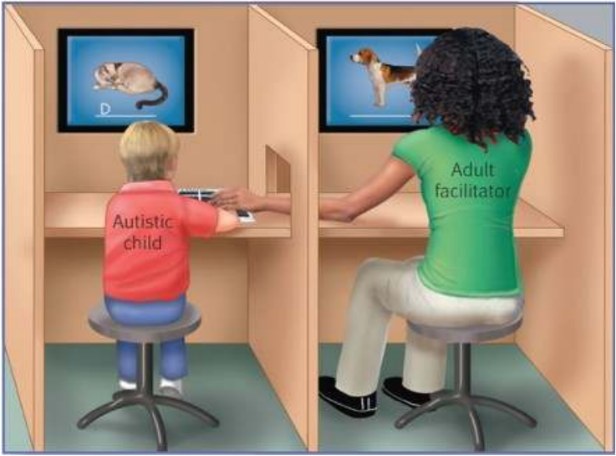
Initially, both facilitator and child were shown the same pictures, and the child, with the facilitator’s help, correctly typed out what was revealed to both. Then, the child was shown one picture, and the facilitator was simultaneously shown another. The child, with the facilitator’s help, correctly typed out the name of the item that the facilitator saw, not the item that only the child saw.
The Reality
The O. D. Heck Developmental Center in Schenectady, New York, where staff had enthusiastically practiced facilitated communication, did not achieve a single valid communication after 180 such trials.3 Ray Paglieri, director of the autism program at the center, had to tell well-meaning facilitators that the children were not typing the words. The facilitators themselves were. The relationships they thought they had with the children were conversations they had only with themselves.
Other researchers found the same thing. By the end of 1993, not one of over a dozen studies showed that facilitated communication ever originated with the child. Instead of unlocking the hidden thoughts of autistic children, the technique uncovered the unconscious thoughts of the facilitators.
Morley Safer’s 60 Minutes report examined claims that facilitated communication worked brilliantly. The program concluded, “So far, there is no convincing objective evidence to support those claims.” Hugh Downs on ABC’s 20/20 came to a similar conclusion.4 An eye-opening PBS documentary described an institute at Syracuse University dedicated to facilitated communication as “researching, teaching and promoting a technique that all the scientific evidence says is not real.”2
In 1994, the Council of Representatives of the American Psychological Association (APA) passed the following motion: “Be It Resolved that APA adopts the position that facilitated communication is a controversial and unproved communicative procedure with no scientifically demonstrated support for its efficacy.”5
The association reaffirmed its position in 2003, stating, “Study after study showed that facilitated communication didn’t really work.”6 In June 2008, the American Academy of Child and Adolescent Psychiatry said that facilitated communication “should not be used to confirm or deny allegations of abuse.”7
As for Robert, the case against him was eventually dropped.2
The Reaction
The reaction? Jim Maruska, a facilitator, admitted that he cried and likened the discovery to the death of a close friend. Suddenly, what was so real no longer existed. “I centered a lot of things around this and now, all of a sudden, ‘No, it’s not.’”

Marian Pitsas, a speech pathologist and facilitator, was distraught. She had to tell parents that facilitated communication “wasn’t real.” She had to acknowledge that she was “dead wrong” about the whole thing. For months, she could not broach the subject without dissolving into tears.
The experience of psychologist Doug Wheeler was much the same. He remarked, “It was amazing to me to see how willing people are to abandon their beliefs and adopt a new belief without verification and do… virtually overnight, because it happened to myself.… I was so caught up in the emotionality of it.”
Insight Into the Human Mind
This story is fascinating because there is no indication that these educated and dedicated facilitators succumbed to delusions. What is striking is how one’s belief and emotionality can create an error of major proportions. The facilitators were not only wrong about facilitated communication, but they were wrong about the thought process going on inside their own heads!

The train comes from the other direction!
A Lesson for Marriage
We will have never-ending discord if we only look at our partner as being at fault for our relationship problems and fail to look within. Our spouse may be wrong in various ways, but is that the complete story? What about our contributions? To what degree are we holding onto error? To what extent do our spouse’s responses correspond to our own off-putting beliefs and behaviors?
Think about who the facilitators were: caring, educated people who badly wanted to help, with feelings running high. Most of us are in that same state during a fight with our spouse. We care deeply, and we’re sure we’re right.
In my own practice, I can recall cases where one spouse was suspicious that the other was cheating on them, either physically or emotionally. But the truth of the matter was, the suspicion grew out of that person’s own insecurity, not reality. Like the facilitators, they were writing their own false narrative.
We should be open to looking within when considering why our relationship is so strained. The more willing we are to admit our thinking may be wrong, the more likely we are to have peace in our home. The truth may hurt, but it is better to accept the truth than to live a lie.

Discuss
Why Is Admitting You’re Wrong So Hard?
- A.There are two pertinent questions you should each ask yourselves.
- 1.What is the evidence that supports my thought or opinion?
- 2.Even more importantly, what is the evidence that does not support my thought or opinion? To answer this question honestly takes courage. It can also lead to peace.
Here’s how to put these two questions to work. Each of you should do this on your own before you talk.
Write it down. Put your belief about your spouse into one sentence, such as “She never listens to me” or “He doesn’t care how I feel.”
Separate facts from conclusions. Under the first question, list only what you actually saw or heard, the way a video camera would record it. “He looked at his phone while I was talking” is evidence. “He doesn’t care” is a conclusion you drew from it.
Look for the exceptions. Under the second question, list the times your spouse acted in ways that don’t fit your belief. Watch for words like “always” and “never.” They rarely survive this step.
Consider another explanation. For each item on your first list, think of at least one other reason your spouse might have acted that way. Maybe he was worn out, or waiting on an important call.
Check it out with your spouse. The researchers put the facilitators’ impressions to a test. Put yours to one too. Say, “Here’s what I’ve been telling myself about what you meant. Is that right?” Then listen without arguing.
If your belief holds up, you can raise it calmly and with specifics. If it doesn’t, you’ve spared both of you a fight you didn’t need.
- B.When discussing the question, “Why is admitting you’re wrong so hard?” one man said:
Every time I tell myself next time, I will admit, “I am wrong.” But then when the time comes it’s just so hard you have no idea. It literally feels like at that point I should go ahead and say, “Hey guys I’m an idiot, make fun of me.” … I KNOW that admitting your wrong is like the opposite of being dumb. But again it just feels so hard to admit it and I hate myself for that. Maybe it has to do with the way I was raised.8
This person knew the difference between right and wrong. He didn’t acknowledge the error of his ways because, emotionally, he couldn’t handle it.
If this man’s experience is like yours, is there anything your spouse can do to make it easier for you to open up, be true to yourself, and acknowledge reality?
A hint if you get stuck. How you respond when your spouse admits a mistake decides whether you’ll ever hear another one. An “I told you so” confirms the fear. A simple “Thank you for telling me” makes the next admission easier.
Once you can admit you were wrong, the next question is what a sincere apology looks like. That’s the subject of the next chapter, “How Do You Know If Your Spouse Is Truly Sorry?”
1. Carlyle, Thomas, On Heroes, Hero-Worship, and the Heroic in History (1841), Lecture II, “The Hero as Prophet.” His exact words: “The greatest of faults, I should say, is to be conscious of none.” ↩
2. Palfreman, Jon, “Prisoners of Silence,” Frontline, PBS, October 19, 1993. The documentary includes the January 1992 PrimeTime Live broadcast, the case of the father called Robert in this chapter, and the O. D. Heck Center study, with interviews of Jim Maruska, Marian Pitsas and Doug Wheeler. ↩
3. Wheeler, D. L., et al., “An Experimental Assessment of Facilitated Communication,” Mental Retardation 31, no. 1 (1993): 49-60. ↩
4. Safer, Morley, “Less Than a Miracle,” 60 Minutes, CBS, February 20, 1994. Hugh Downs’s 20/20 report on facilitated communication aired on ABC in April 1994. ↩
5. American Psychological Association, “Resolution on Facilitated Communication,” adopted by the Council of Representatives, August 14, 1994. ↩
6. American Psychological Association, “Facilitated Communication: Sifting the Psychological Wheat from the Chaff” (2003). ↩
7. American Academy of Child and Adolescent Psychiatry, “Facilitated Communication,” policy statement approved October 20, 1993, and reviewed June 2008. ↩
8. “Why Is Admitting You’re Wrong So Hard?” Discussion on Reddit, r/CasualConversation. ↩
Struggling in your marriage? There is hope.
Call Dr. Ken Newberger at 561-490-4991 to talk about your situation free of charge. Or, if you prefer, learn about his unique process.